
Rust and rot ruin metal and wood materials, and columns are no exception. However, neglecting a weakened column can cause damage or pose a danger. In this blog, we’ll teach you how to handle rust or rot in your home’s columns.
In these circumstances, you can probably repair the damaged column:
- Only minor paint damage on the column
- Rust or rot is visible in a small area and has not spread elsewhere
- The rot is shallow, and the wood is still firm when pressed with a pencil tip
But if the damage is severe, replacing the column becomes your best, and often only, option.
This table guides you on the best way to handle rust or rot in columns:
| Condition | Repair | Replace |
| Rust and rot are detectable in limited areas, and the column’s core is still firm | ✅ | ❌ |
| Rust and rot are detectable in limited areas, and the column’s core is still firm | ❌ | ✅ |
While this offers a brief overview, we’ll explore this issue in greater detail below. Stay tuned for comprehensive insights. Let’s begin by understanding the cause of this issue.
What Causes Rust or Rot in Columns?
Moisture is the primary suspect here. It damages both metal and wood. Therefore, columns that are frequently exposed to dampness, such as those in open areas and damp basements, are more susceptible to rust or rot.
When wooden columns are enclosed and hollow, they are more susceptible to decay as trapped moisture creates the perfect environment for it. Moreover, wood-destroying pests, such as termites and carpenter ants, can exacerbate the damage.
Additionally, placing wood columns in direct soil contact is a poor choice, as it reduces their lifespan.
For metal columns, moisture and oxygen cause rust to form. This oxidation destroys the metal from within over time.
Moisture remains the key factor. Ignoring proper coatings, especially where water pools, accelerates rust on metal columns.
Experts recommend setting up proper drainage and landscaping around metal columns to minimize ground moisture. Construction companies also advise planting suitable vegetation nearby to prevent moisture issues.
Now that you know what weakens your property’s columns, let’s explore the best solutions. How should you address rust or rot in columns?
Repair vs Replace: How to Decide
As experts, we recommend repairing a damaged column whenever feasible, since replacement typically comes with a higher cost. However, severe rust or rot may necessitate the removal and installation of a new column when repair is not structurally viable.
The question is how to determine which option is best suited for your specific situation. Luckily, making the right decision in this case isn’t difficult. Let’s see.
Repair the Damaged Column if…
Whenever the damage is localized (meaning it is limited to a small area), you can proceed with repairing the column, whether it is made of iron, steel, or wood. For example, if only a tiny part of the column is affected and the core wood or metal (the innermost, structural part of the column) remains sound, different repair methods can help you overcome the issue. If it’s a wooden column, use a sharp pencil to test its firmness. If the material resists the pencil and doesn’t easily dent, there is hope.
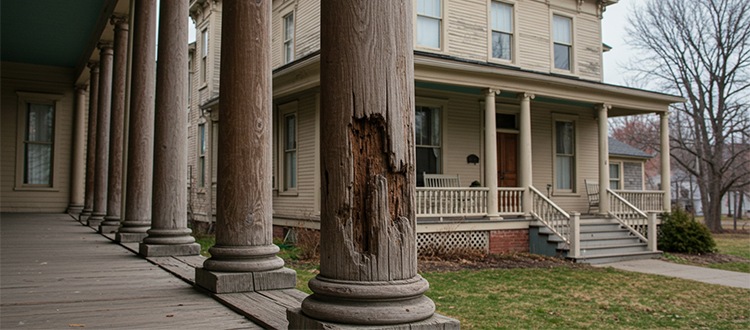
Moreover, when dealing with rust or rot on decorative columns, or those that are not load-bearing, you can choose to repair the affected areas, regardless of the extent of the damage.
On the other hand, we have some serious situations that leave you no choice but to replace the troubled post.
There is No Choice But to Replace the Column, if..
When the corrosion or decay is deep and widespread over the column, be prepared for the cost of a full replacement and installation of a preferably newer alternative, such as fiberglass columns. If the column feels spongy or fragile, it’s a clear sign that it must be replaced. Ignoring these serious signs will lead to severe consequences that no one wants to deal with.
Please note that if you’re struggling with rust or rot on load-bearing columns, it is best to react as fast as possible, before you see the ceiling falling on your head!
If you’re unsure whether to repair the compromised column or replace it entirely, contact us for a professional consultation.
Ask Experts to Inspect Your Home’s Columns
Not sure if your damaged columns need repair or replacement? Reach out to us today, and our skilled professionals will visit your site to help you find the best solution.
Examining Repair Methods
Most of these techniques are specialized and require years of experience and practice to be performed correctly.
When dealing with rot on wooden pillars, you have a wide range of choices to fix the issue if the damage is minor. We’ll explore them here.
Epoxy Consolidant & Filler System
The first option is to use a high-quality epoxy consolidant, a liquid that penetrates and strengthens the wood fibers, to reinforce the wood.
To do that, remove the loose or rotted wood first. Then, apply the consolidant to the damaged areas to ensure complete absorption and wait until it has hardened. Next, start applying epoxy filler (a paste that fills wood gaps) to the areas where you removed loose wood. Let it cure, then sand it. Finally, you can repaint the column to restore its appearance.
Splice & Scarf Repair (Dutchman patch)
Another method is the splice & scarf repair, which is a highly technical process. In this approach, you cut away the decayed part of the wood and then craft a replacement piece that fits precisely in that area.
Resin Glue with Dutchman Strips
If it’s a round post or one with elaborate details, the best option is probably using resin glue with Dutchman strips. Dutchman strips are custom-cut inserts designed to repair damaged areas of wood. The procedure is the same as the splice & scarf method, but with the difference that you should use resin glue, a strong adhesive, for attaching the crafted piece to the damaged section of the column.
Wood Hardener + Filler
A further option involves a combination of wood hardener and filler. After removing decay from the column, dry the wood thoroughly. Then, drill holes, saturate with hardener, and replace the missing material with filler.
Now, let’s see how to deal with rust-covered columns.
The Most Common Approach For Repairing a Rusted Column
Use a wire brush or grinder to remove the rust. Apply a rust converter, which chemically changes rust into a stable surface, or a sealer to deteriorated areas.
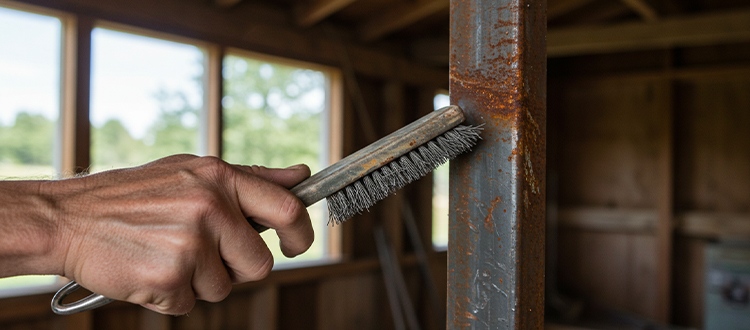
It’s also important to address any gaps or omissions in the post. You can use a metal epoxy (a strong adhesive for metal) or weld in a patch piece. Then, prime the surface and paint it with a corrosion-resistant coating.
Replacement Scenarios
Our experts have handled numerous cases where porch column replacement was the safest option, such as a wooden column in a client’s house that was badly damaged by rot.
In another case, the iron pillar our specialists examined was heavily rusted and would have continued to deteriorate without immediate replacement.
Some clients also chose to replace old columns with modern alternatives, such as PVC, for various reasons.
Lastly, in some historical structures, severely damaged columns had to be replaced with custom alternatives to preserve the vintage aesthetic and structural integrity.
In the final section, we’ll discuss ways to prevent rust or rot in columns.
Prevent Future Rust and Rot
Consider these tips to prevent rot and decay in wooden posts:
- Use rot-resistant or treated wood for building columns.
- Elevate the pillar base with a porch to avoid direct contact between the wood and soil.
- Install proper drainage and ventilation systems to minimize the destructive effects of damp.
- Seal all sides, apply a good primer, and then apply multiple coats of paint.
- Put flashing or copper drip caps on top of the pillars.
Keeping a metal or steel column in good shape is relatively straightforward. Using weather-resistant steels or utilizing galvanized covers can significantly reduce the risk of rust. Applying rust-resistant coatings, such as zinc/aluminum, is also suggested. Let’s wrap things up.
Conclusion
In this blog, we provided comprehensive information on rust or rot in columns, explaining when to repair the column and when to replace it. Additionally, we discussed various repair methods and some scenarios in which experts decided to replace the column.
At Roll The Wall, we’re ready to help you solve this problem effectively, whether it involves fixing the damaged column or replacing it with a new one. Contact us now to discuss the best solution for your specific case.
FAQs:
- How do I know if my column can be repaired?
Minor rust, rot, or shallow damage to the core of the column indicates that the problem can usually be repaired. However, asking for a specialist’s opinion is advised.
- Is rust on a steel column dangerous?
Yes. If rust is widespread and not properly addressed, it can cause serious damage, mainly if it affects a load-bearing column, potentially leading to structural failure.
- Can I repair rotted wood with filler?
Yes, using filler is a practical approach to fix rotted sections. However, it’s a specialized process, and it’s best left to professionals.
- How much does column replacement cost?
Several factors affect the cost of column replacement, for example, the type of replacement material you choose. Generally, prices range between CAD 799 and CAD 1,399.
- How can I prevent rust and rot in the future?
Using proper materials, installing adequate drainage and ventilation systems, applying rust-resistant coatings, high-quality primer, and multiple coats of paint are effective ways to prevent future rust or rot.
We’d love to hear from you in the comments! Have you dealt with rusted or rotted columns on your porch, in your basement, or elsewhere? Share your stories, solutions, and even the mistakes you’d warn others about. Your advice could really help someone facing the same challenge!
